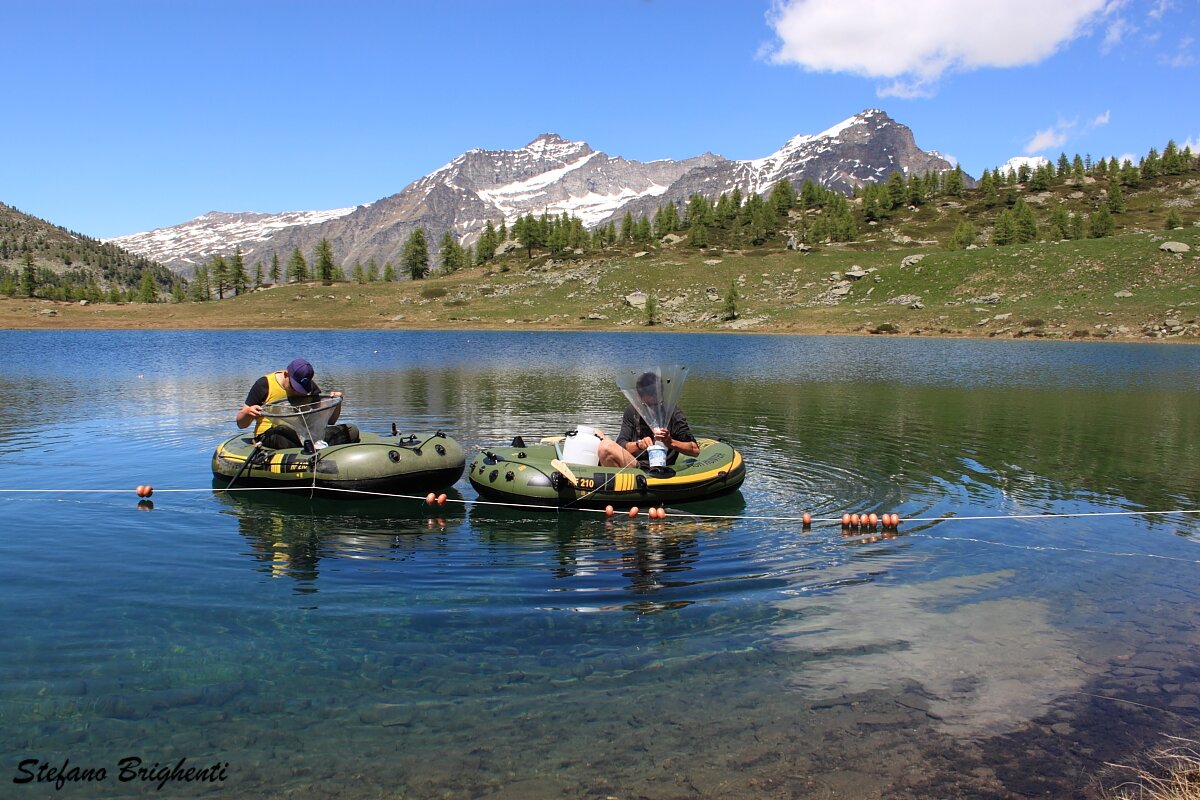
The prestigious international scientific journal “Hydrobiologia” has dedicated its front cover to the Gran Paradiso National Park (http://link.springer.com/journal/10750/709/1/page/1).  On the inside of the cover page, the caption of the beautiful photograph by Antonello Provenzale says: “The Dres lake is a small mountain lake located at the border of the Gran Paradiso National Park. Its ecology has been deeply researched in the last years, but despite its breathtaking appearance, its ecosystem is seriously threatened by the presence of introduced fish. The Park is currently bringing forward an eradication program which aims to restore the natural ecological equilibria of the Dres lake and other Alpine lakes”, showing the great interest of the academic community towards the efforts of the Park to actively conserve biodiversity.
Inside the same issue a “made in Gran Paradiso” paper has been published(http://link.springer.com/article/10.1007%2Fs10750-012-1405-5) din which the authors tackle some aspects of one of the most impressive - but less known to the general public - natural phenomena: the vertical migrations of zooplankton. Indeed, zooplankton (very small aquatic crustaceans) does daily migrations towards the deeps of lakes and oceans during the day and towards the surface during the night. This phenomenon still presents some unclear aspects, despite scientist explore the causes of these mass migrations since more than a century. The question, indeed, is not at all secondary: The zooplankton migrations, considering the boundless surface of oceans, represent the largest coordinated movement of living organisms in the whole world, involving a much bigger biomass than the better known migrations of birds or of ungulates in the African planes!

Diagram of daily vertical migrations of zooplankton