An update on the actions C.1 and C.2: eradication of introduced fish
Alien fish for recreational fishery have been introduced into once fishless mountain lakes worldwide, representing a major threat for biodiversity. Introduced fish are likely to survive in mountain lakes even if they are no longer stocked until an active eradication action is not implemented. For this reason, Bioaquae provides for the eradication of introduced Brook trout populations (native of North America) from 4 alpine lakes: 3 small lakes (Lakes Djouan, Nero, and Dres) and one relatively large lake (lake Leynir).
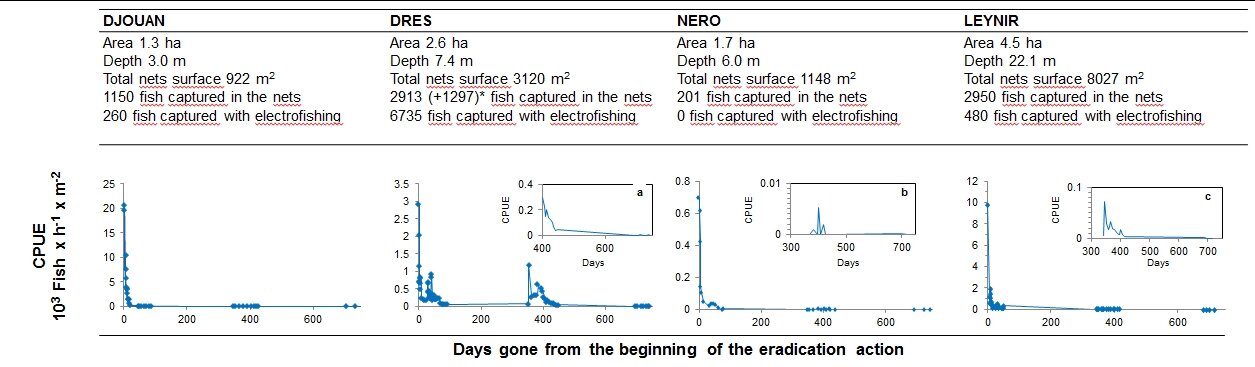
Eradication will be considered concluded after one year without fish captures. After more than 2 years of field work, the eradication actions were successful in eradicating S. fontinalis from one small lake (Lake Djouan), while the fish population collapsed to values close to zero in the other three lakes.In lake Nero the last fish was captured during the winter 2014-2015. In lake Dres we captured about 20 fish during June-July 2015 and only 5 fish in August 2015, in spite of an intensive capture effort with nets and electrofishing. In lake Leynir we captured only 4 fish in the course of the summer 2015 and it is a few weeks that the captures collapsed to 0.
In the complex the eradication action follow the schedule of the Bioaquae project. There are also strong evidence of ecological resilience, with macroinvertebrates and Daphnia sp. being particularly sensitive to fish removal, but a longer resilience period is needed to understand the long-term ecological consequences of this restoration project.
Figure legend: Capture rates expressed as Capture Per Unit Effort (103 x Fish x h-1 x m-2). The main morphometric data as well as the data concerning the capture efforts in each lake are provided. The points indicate the dates in which the fish have been removed from the nets. In lake Djouan the CPUE dropped down to 0 at the beginning of the second field season, while in the remaining lakes it decreased close to 0. To highlight the capture rates when fish density was very low (starting from day 300-400) we rescaled the Y axis of Panels a-c. * Some additive nets have been added in lake Dres to capture many fish hidden the littoral vegetation